Editor’s Note
Cente Watkins’s The Pokey Principle has become the seminal work in Pokey Studies, but has, hitherto this publication, remained largely unapproachable to the common reader. My goal in creating this abridged edition was to arrange, collect, and ignore the chapters in Watkins’ book in such a way that an interested non-expert could readily enter the study of Pokey the Penguin. To this end, I have greatly reduced this work, trimming 3,507 pages down to several dozen. Most of my associates have agreed that surprisingly little was lost through my labor.
The introduction has been significantly trimmed down, in that it previously described the whole of the book. I have altered it in such a way that includes the discussion of Rudger Beerglass’s famous essay, and a mention of the Yoko and Pogo Principles, but little else.
The first chapter was decreased enormously when I chose to include only nine of Agosto’s Pokey analyses (the original work contained in excess of three hundred). I have deleted all of Watkins’ accompanying responses. Agosto’s "ironical halo" theory is presented in condensed form; before my replacement, Agosto’s own comments on the subject were taken, verbatim and unedited, from his 1990 book, Pathological Primas, and stretched across ninety pages.
The second chapter retains the whole of Watkins’ commentary on a selection from Thar Sets Zahutu’s Parka!, which is uncommonly short. I have removed his less interesting comments upon Crap’s Stevon (a transcribed, or possibly invented, dialogue between Steve Havelka and Stoolates), as well as those concerning The Book of Moron and Bennigan’s Barmitzvah.
The final chapter ("Chapter 3" in this volume, compiled from Chapters 3 through 96 from the unabridged edition) contains a few quotes from various sources, and Watkins’ commentary on these quotes. I had considered cutting this third chapter entirely, but was finally convinced that without it my new edition would be too thin to pose as a relevant text.
The resulting structure of the book is somewhat uneven, the introduction and first chapter being much longer than subsequent sections. This uneven organization was unavoidable, as I was unwilling to combine Chapter 2 with Chapter 3, which was already a simplified representative of ninety-four chapters. Combining ninety-five chapters into one struck me as disrespectful to the original work, and I was thus forced to create two smaller chapters after Chapter 1.
In several places where the original text is uselessly wordy, I have inserted my own summaries.
[Editor's note 2006: The above note is no longer accurate, as the book has been reduced even further.]
Introduction
Why
There Are Master-Pieces And What Are The Few Of Them (Cambridge Version)
by Rudger Beerglass
So we have photography now, and anyone with any sense is saying: what's the point of drawing something inexactly when you can photograph it exactly? But a million people respond: oh, we just like that flavor, you know, of the old school drawing and painting. Well, so be it, but nostalgia for the past can hardly be grounds for an esthetic theory, and really, no matter how stupid the past was, you'll have people feeling sorry for having lost it. Nevertheless, there is something there, and certainly there is some freedom in the inexactness of art, and that may be what they'd really mean if they had any sense. But then, the paintings are useful insofar as they don't reflect reality. So what's going on here?
And of course, with computers now, it takes a click or two and any photograph is converted into the old-style paint or ink or black-and-white. Those simple transformations don't do it any more. Art has to come from something much higher, much more thoughtful and revolutionary and unexpected, and so convinced am I of this truth that I feel uninhibited shouting: representational art is dead.
Picasso wasn't all that important from an idealistic standpoint, because all he did was make beauty, and it took at least one other person to say, "Look, he has made beauty, and it's nothing like we thought it was." But of course, millions of people were saying that. But that just opened the same old can of worms, because then people were looking: well then, what is beauty? And is cubism beauty, or (and then Dali and Bunuel and a million other freaks popped up) is it surrealism or what? And what they didn't realize is that all those fads would pass and what we'd finally realize is that beauty is everywhere, and so utterly simple to discover and reproduce that art is unnecessary.
Which is not to say that art is unnecessary. Our romantic inclinations would like us to believe that looking at a painting is something holy and incredible, but we know from experience that any woman on the street, that is any woman, beautiful or ugly, is a million times more interesting than the Mona Lisa. But how can that be? you say. The Mona Lisa is being studied and talked about and worshipped centuries upon centuries after its creation, but these people will die and be forgotten. YES, and that is true, but that is because no one will take it into their heads to study them. I look out my window now and I see automobiles racing to and fro, and if Da Vinci had created an automobile, we would be talking about them every day in awe and wonder; we would drive the Mona Lisa to work. The problem with art is that it involves creation by an artist. The Mona Lisa is not considered an important work of art because the woman herself is of any interest, no matter how many people want to argue about who she was and was she Leonardo and why is she smiling? People look like her everyday, and have much more beautiful smiles. The Mona Lisa is studied because people want to know more about Da Vinci, and this is not a sensible way to judge the importance of art.
Drawing people is hard. It is very difficult to make the Mona Lisa, and it is somewhat beautiful, and in everyone's minds there's this bizarre superstition that the harder someone works to make something beautiful the more beautiful the thing is. So people spent a lot of time working out proportions, and digging symmetry and whatnot, and then, because it had all gotten very complicated, even though it had nothing to do with beauty anymore. You hear a lot about the golden rectangle, about how it has the proportions that are the most beautiful to the human eye. This is total crap, as scientific trials have proved repeatedly. And yet it’s still taught in art schools across the world, because people want it to be true. Eventually people had to study and work hard and try a lot to make something beautiful, and then everyone felt obliged to admit, yes, that is very beautiful.
This is certainly not limited to the visual arts, or the Renaissance. It still amazes me that people are blind enough to pretend that Ulysses is a readable, let alone beautiful, book. I have read it; I do not speak in ignorance. I have read the unreadable, read about the unreadable, and I cannot claim to understand everything any more than anyone else; but what difference does that make? Does it make the book any more beautiful to know that Joyce painstakingly inserted reference after reference to Shakespeare and Homer? Certainly not, especially if you need a few additional volumes to educate you about the references. Writing that way simply made writing Ulysses more difficult, and we assume that makes it better, but it doesn't. Beauty is not mathematically proven, or painfully extracted; the only joy to be had from reading Ulysses is the smug satisfaction of having understood something that very few others will, and happily pretending that they are worse off for it.
And Bach provides a happy dichotomy, for the majority of his works are beautiful and pleasing to all of the masses. We hear the name Bach, and we know to expect beauty. Yet, what among the scholars is his end-all being of genius? A Musical Offering, the most horrid and disappointing work I have ever heard. Bach has taken a dreadful theme, transformed and fixed it about itself, with different tempos and inversions and variations, and we are left with a mathematical abstraction, an offensive and perverse disdain for the human listener. Beauty is not mechanics.
Let us say that a different way. The problem with art, as has been throughout known time, is this: people have found beautiful things, and tried to isolate the properties which made those things beautiful, and then generalized those principles for use in production of beauty. The method seems sound enough, admirable enough, and simple enough. So what has gone wrong?
We all know by now what has gone wrong. There is no single, great, Platonic beauty. The very idea of beauty is impossible to define, when we realize how subjective the experience is. For some, beauty is a flower, while for others, it is raping children. How do we abstract from these facts? How do we build a general theory in view of the fact that beauty changes from person to person, from epoch to epoch?
Well, many would like to claim that great art is great art precisely because it generalizes to so many times and people; Beethoven is great because everyone everywhere loves Beethoven. The Sex Pistols are not great because no one will like them in the distant future, and very few people like them now.
I am not deeply opposed to this rating of art, but I still find it weak in application. Artists from the past enjoy a much greater position in the world than newer artists. Beethoven was the greatest composer in the world in a time when the world's population was next to nothing (compared to our modern days, I mean). He also lived in a time when the poor and starving were highly unlikely to become professional composers (though certainly this occurred). In Beethoven's days, in most anyone's olden days, it was not nearly as difficult to be the greatest composer on earth.
Shakespeare was a very good writer, but he is not remembered today just because of that. Most people do not even enjoy reading Shakespeare; he is a grudging task in high school, and an angelic bogeyman before then. Afterwards, he is probably neither seen nor heard, save for the odd phrase that we borrow from him. And in fact, there's the pudding: although Shakespeare’s plays are now performed and attended for dubious reasons, his words and phrases still exist in the common tongue. There is no other work that has so ingrained itself in the minds of English-speaking people, with the possible exception of the King James Bible, as the works of Shakespeare.
But I digress; I apologize, because praising Shakespeare is a redundant practice in this world. That is part of the problem. Shakespeare was not a terrific innovator in the realm of plot; everyone knows that he stole all his storylines. He was not at all experimental with the organizations of his plays: all five acts, with predictable climaxes and resolutions. He did not display any insight into human nature or individuality; all of his protagonists speak with the same gigantic metaphors, with the same long-winded asides, with the same exaggerated emotions. Shakespeare's plays are all somewhat laughable in their predictability and fakeness.
Why can we not separate the two? Shakespeare was a poet, and a wonderful turner of phrase, but he was not one for plot or characterization. Well, even as I say that, there are at least a hundred books in existence ready to contradict me, as would be the case no matter what one chooses to say about Shakespeare. William is so well protected in the scholarly eye that it is difficult to take a shot and be taken seriously. And although it would not be difficult to find people who agree that Shakespeare's plots and characters are weak, dismissing Shakespeare because of those faults is unthinkable.
Influence. Shakespeare's plays, no matter how weak and silly, cannot be allowed to die, because they have inspired so many other great works of art. Let Shakespeare fall, and where is Joyce? Being old, and having been loved a long time, an artist is unlikely to fall. Why else is Homer regarded as history’s greatest poet, when virtually no one (by percentage) can read him in the original Greek? Why else is Michelangelo history's greatest visual artist, when virtually no one (by percentage) has seen David? There is too much scholarship, too much history, too many assumptions laid in place by the intelligentsia. Dylan Thomas better than Homer? Ridiculous. Pokey the Penguin better than the Sistine Chapel? Get out now.
The sad and obvious truth of the matter is that art, once formalized or mechanized, is no longer art; and the few arts that have not been formalized are now being mechanized. There is no mystery or talent required to create "artistic" beauty; and if a talentless person can do it, why should we give any regard to those who require talent to produce the same result? John may spend a week painting a tree, but Jane will take a photograph, and then use a workshop program to make the picture appear painted. There is no visual art created before the last century that modern technology would not have allowed a less talented person to make better and faster. Let us be realistic and assume this trend will continue. There is nothing we can do to avoid the solemn fact that Michelangelos are no longer needed.
Now, what about ideas? Visual arts are something else, of course, and by visual arts I don't mean to include film; but what about music and literature and poetry? Now, it used to be that words and poetry told stories. The stories weren’t even constant then, and a sense of that remains, which is to say, some people think that it is the plot of a story that matters. But the plot doesn't matter very much, because it's not very difficult to think up plots. Good plots don't make books interesting, really, and they certainly don't make poems interesting, although bad plots can ruin anything.
Take the Iliad, for example. Does anyone really care about all these gods and goddesses, and Trojans and Greeks and things? Certainly not, and anyone who really does can read a plot summary in five minutes. The manner of telling the story is what makes the story art. Now, in poetry, there's an obvious mechanism there, or there used to be: rhyme, meter, whatever. But it's pretty easy to put a story into any given meter, into any given rhyme scheme. So that's not what makes poetry great.
But, maybe I should dip my hand. Poetry wasn't great. And if you go back to the original Iliad, it's doggerel. But then, what rhyming or metrical poetry isn't? When most of the population is illiterate, it's a big deal to be able to set down thoughts for future generations. There were no other lasting voices beyond the literate, although it's ironic that I say that since Homer never wrote anything down. Anyway, the point is that when millions of people know how to read and write and measure meter, anyone can make poetry as good as Homer's or Shakespeare's. The problem is that they are old, and if you try to do anything people are going to say you are not doing it as good as they did, unless you rip them off, and then people will say that you are ripping them off and therefore not as good as they were. You might as well toss in your hat in the poetry game, if you want to be the greatest there ever was.
What then literature? Anyone can write a book, and although many books are very enjoyable, most people would rather watch the movie than read the book. And movies are almost always terrible. Books get along by having some kind of appeal to some certain group of people, but very few books actually seem beautiful to any large group of people unless the book has some political or social message, in which case you don't know if people like the book or the message. And anyway, once the movement passes, the book can be dismissed. Look out now, Ayn Rand, Camus; your days will not last long.
But I'm probably slipping away from you here; so let me see if I can catch you back up. Most books that are thought by scholastic institutions to be great books do not appeal to the masses. Most books that appeal to the masses will not be of interest to anyone in a few decades. There's no real connection between the artistry going into a work and the beauty coming out. Esthetics is dead, and rightfully so, because if you care about beauty, art is not your concern.
With a few exceptions, of course, and those being master-pieces.
Because although everything will be mechanized and formalized some day, there will always be something which has not yet been. Master-pieces will only stand for a little while, of course, depending on how well they hide their form. Keep in mind here, this has nothing to do with beauty at all. It has only to do with art being irreplicable.
Already, everyone will object to the idea that master-pieces are only master-pieces temporarily. I apologize, but that is the way things are. […] Anything formulizable is mechanizable; and anything mechanizable is reproducible.
It is hard to say how long master-pieces will stand. To some degree, we might consider the length of life as ranking of greatness. Although I have chided him earlier, Joyce is a master of master-pieces, having two very different god-works to his name (a true rarity for artists, as their best works often supercede all lesser works). Ulysses and Finnegan’s Wake are sufficiently complicated that they have not yet been completely understood, let alone formalized. No one has yet successfully imitated Joyce; they have come close to Ulysses, but Finnegan’s Wake is a horrible tangle of confusion that a thousand scholars working for a hundred years have not unraveled. Work is ever proceeding forward, and someday the work will be dissected, and we will know exactly how every piece was made, and what his tendencies were, and computer program, properly equipped with dictionaries, will begin to churn out polyglot puns and scatological references. Will it be Joyce? It will be better. But until that day, he is our king.
In music, the noisy and persistent Beck Hansen is our focus. Not that he has made a master-piece, of course. The Beatles made the last known master-piece with the White Album, which mysteriously arose from the bowels of popular music. After and before, noise and formulas. Thirty years passed before Beck Hansen arose and began to reinvent music, with lessons drawn from every pathetic, failing genre. The key to masterful music is not reiteration of ancient genres, or collective participation in a growing movement, or random desperation to avoid conformity. Beck took all the sounds he heard, in life, in music, in dreams, and wove them together into ever-changing, undefinable life’s work. The musical master-piece must avoid the static compositions of notes and paper, and seek out all the sounds of the world and studio; bars and notes are limited and predictable, but the world offers infinite surprises. Beck has learned to coordinate sounds like an orchestra. When he is dead and finished, we may stand back and formulize, and create the master-piece he never could; for no single work of his stands sufficiently from the others, and none have surpassed the Big White. For now, we watch Beck Hansen silently, and pray for the fulfillment of his destiny.
The visual arts are a vacant, scorched wasteland. There is only one body of work which has raised its head, above all history and tradition, to become the master of all that is seen. Pokey the Penguin, an obscure and anonymously-authored internet comic strip, has staked its reputation on the ability to remain novel in severely constrained medium. Using repasted images, crude hand drawings, consistent panel lengths, and an eternal setting, Pokey the Penguin has explored the depths of humor and irony in a limited, symbolic setting. Of all the master-pieces still surviving on earth, Pokey the Penguin may likely be the hardest to formulize. Until some scholarly attention is paid to this work of genius, the underlying structure will remain hidden, and the master-piece shall stand before us.
Ladies and gentlemen, it is our duty to destroy every master-piece that comes before us. Esthetics has assassinated the early arts, but beauty is no longer our concern. We must uncover forms and patterns, and show the emptiness of the past. Art has value only insofar as it is beyond our comprehension, only insofar as it forces us to look deeper and farther to discover its source.
I have spent a lifetime searching for master-pieces, and indeed the ones I have named may be somewhat suspect; I have chosen to err on the side of caution and ascribe greatness whenever possible, even if I am not perfectly certain of a work’s master-piece status. You may well disagree my particular choices. I take no offense. These distinctions are small. What we must accept is our solemn duty as critics, scholars, and artists. We must dismiss those works which no longer retain hidden treasures. We must seek means of creation that evade known formula and mechanism. We must seek out those works that yet remain in shadow, and endeavor to illuminate them.
We have been handed the torch. Let the burning begin.
[Editor’s summary: At this point, Watkins begins a long-winded assault against the Beerglass lecture. He notes several inconsistencies, such as Beerglass’ condemnation of Shakespeare’s plots and his later assertion that plots don’t matter.]
The first two books published in response to the stunning Beerglass lectures were The Pogo Principle, by Winstence Kant, and The Yoko Principle, by Penny Witchblood. Beerglass had not made any claims requiring strong refutation, but Kant and Witchblood nevertheless took up arms against him. Kant and Witchblood thus had a common enemy, but were also adversaries; Kant dismissed Pokey as trash based on randomness and inside jokes; Witchblood likewise accepted the randomness of Pokey, but claimed that the random surrealism of Pokey made it an important and beautiful work. Both Witchblood and Kant did a disservice to Pokey, but it was not until Alfred Dutsch Agosto’s Pokesthetics was published that the structure and logic of Pokey was brought to light (see Chapter 1).
Kant attacked Pokey the Penguin while promoting the traditional masters of the comic strip: George Herriman (Krazy Kat); Charles Schulz (Peanuts); Bill Watterson (Calvin and Hobbes); and particularly Walt Kelly (Pogo), whom Kant considers the greatest comic artist in history. In the following passage from the introduction to The Pogo Principle, Kant shows his disdain for Pokey the Penguin and its defenders:
Pokey the Penguin’s followers attribute to it some amount of importance based on the fact that it has spawned so many imitations. However, even laying aside my profound doubt about Pokey the Penguin’s originality, I do not see the value of inspiring creations that everyone admits are terrible. Moreover, as none of Pokey’s fans seem to understand its alleged hidden structure, of what importance was its short-lived, mediocre popularity? The quantifiable facts of the matter do not lend any value to this pathetic abomination.
As for the supposed structure…the truth of the matter is that any piece of art, no matter how worthless or patently inferior, can be glorified through sufficiently esoteric analysis. Cente Watkins’s self-indulgent The Pokey Principle is a perfect example of this process. By way of long explorations of irrelevant artistic theories, Watkins creates an illusory association between Pokey the Penguin and complex aesthetics. Such sophistry is similar to mapping mathematical functions onto arbitrary, squiggly lines drawn on a piece of graph paper. Any random creation can be described using complex terms and methods, but this a posteriori pedantry implies nothing about the talent of the artist or the value of the art.
On the other hand, Witchblood praised Pokey wholeheartedly while condemning the silly and predictable amateurs of the past: George Herriman (Krazy Kat); Charles Schulz (Peanuts); Bill Watterson (Calvin and Hobbes); and particularly Walt Kelly (Pogo), whom Witchblood considers the most overrated comic artist in history. In her book, The Yoko Principle (taking its name from the eccentric artist Yoko Ono), Witchblood claimed that surprise and disorder were the most important elements of modern art, and that art consciously based on formulas and patterns was worthless. In the following passage from the introduction to The Yoko Principle, Witchblood shows her love for Pokey the Penguin and its imitators:
Pokey the Penguin’s enemies attribute to it some amount of irrelevance based on the fact that it has spawned so many imitations. However, even laying aside my profound convictions about Pokey the Penguin’s originality, I do not see the challenge posed by rival creations that everyone admits are equally good. Moreover, as none of the imitative comic artists seem to understand the alleged structure, how do we explain their enduring, mediocre popularities? The quantifiable facts of the matter lend equal and great value to Pokey the Penguin and all of its subsequent offspring.
As for the supposed structure…The truth of the matter is that any piece of art, no matter how random or unpredictable, can be trivialized through sufficiently objective analysis. Winstence Kant’s self-indulgent The Pogo Principle is a perfect example of this process. By way of long explorations of irrelevant artistic theories, Kant reveals the discrepancy between Pokey the Penguin and complex aesthetics. Such sophistry is similar to computing a cost-benefit analysis of humankind’s indulgence in art. Any artistic creation can be proven obvious and pointless with sufficient dissection and disgust, but these a posteriori dismissals imply nothing about the talent of the artist or the value of the art.
This book is my response to Witchblood, Kant, and all other critics of Pokey the Penguin. It is largely an archive of important documents concerning Pokey, and the artistic movements it followed or caused. I have supplied my own commentary on all selections; my lengthy correspondences with Steve Havelka have given me an insight and erudition that cannot be matched, and I feel obligated to use my wisdom to shed light on the often misguided opinions of others.
To Penny and Winstence, I offer this immediate rebuttal, that they may read only my introduction and know they have been fools. Pokey the Penguin’s enemies attribute to it some amount of simplicity based on the fact that it has spawned so many imitations. However, even laying aside my profound convictions about Pokey the Penguin’s originality, I do not see the challenge posed by rival creations that everyone admits are terrible. Moreover, as none of the imitative comic artists have understood the hidden structure of Pokey, of what importance are their short-lived, mediocre popularities? The quantifiable facts of the matter do not lend equal consideration to Pokey’s inferior doppelgangers.
As for the hidden structure, you must read further before that is revealed to you, although I take great offense to those who would ignorantly mock this comic masterpiece. To not see beauty where beauty exists is a tragedy, but to deny there is beauty where beauty exists is a crime. The truth of the matter is that any piece of art, no matter how complex or supposedly superior, can be denigrated through sufficiently mechanical analysis. Winstence Kant’s self-indulgent The Pogo Principle is a perfect example of this process. By way of long explorations of irrelevant artistic theories, Kant reveals the discrepancy between Pokey the Penguin and complex aesthetics. Such sophistry is similar to computing the market-value of the chemicals in the human brain. Any artistic creation can be proven obvious and pointless with sufficient dissection and indifference, but these a posteriori dismissals imply nothing about the talent of the artist or the value of the art.
Chapter 1
Pokesthetics
by Alfred Dutsch Agosto
It’s like ten thousand spoons/
When all you need is a knife.
--Alanis Morrisette in Ironic
When I first heard this insipid line, it had a startling effect on me. It was the late nineties, I think, and a friend of mine, Stephen Conway, had decided to extol the simple virtues of Alanis Morrisette’s apathetic anthem of dull observations. My other friends and I grew indignant at Conway’s foolish worship, and we disputed that there was anything ironic about having spoons when you need a knife. The argument soon denigrated into sarcastic bickering, and as I brandished a gigantic dictionary with a triumphant air about me, a dark shadow fell over us. After a few minutes of squinted reading and semantic discussion, we still could not agree what irony was, but we had all agreed that the dictionary was wrong.
In my sophomore year of high school, an English teacher told my class that irony was an unexpected occurrence. We all knew, from common usage, that irony signified more than surprising events, but because we could not put our thoughts into words, we coalesced, and squeezed our conception of irony into the bland package we were given. Sarcasm, for instance, is a division of irony: saying the opposite of what you intend to imply is unexpected, and thus ironic. Finding one thousand spoons before a single knife is improbable, and therefore unexpected, and therefore ironic.
My debate with Conway incited the rebellion I had hitherto avoided through lazy obedience to a lazy instructor. But it wasn’t my teacher’s fault. Irony is improperly defined in every dictionary I have ever seen. Everyone knows what irony means, and most people use the word "ironic" on a quasi-daily basis, but no one has effectively put into words what "irony" signifies. In my searches, I have found three basic definitions repeated over and over. Simplified, the definitions amount to these:
A) Irony: surprising occurrence.
B) Irony: sarcasm.
C) Irony: surprising occurrence that seems to mock expected occurrence.
Definition C comes closest to accurately describing irony, but as we will see, C only captures a smaller subset of irony. For the moment, let us focus on the broader definition of A.
Consider the three following situations, and, using your inherent understanding of irony, decide which one seems most ironic to you:
1) The given name of a librarian is Booker Bookman.
2) The given name of a librarian is Xxx Yyy.
3) The given name of a librarian is Zim-Zam O’Pootertoot.
Of the three, #1 is the least unexpected (or "most expectable"), in that "Booker" and "Bookman" are both existing names. #2 is probably the most unexpected, as the name is unfamiliar, unpronounceable, and unlike all usual names. The third situation is slightly less surprising, in that "Zim-Zam" and "O’Pootertoot" at least mimic the basic structure and appearance of real names (If either of those are real names, I apologize. I have never seen them, and invented them trying to create nonsense words.) According to the dictionarial definition of irony, #2 is the most ironic, #3 the second most ironic, and #1 the least ironic.
However, I doubt that you reach the same conclusion when using common sense (I certainly do not). #2 and #3 are debatable, but #1 is clearly the most ironic. Our task is to discover why.
Obviously, the answer lies in the connection between the word "book" and the profession of a librarian. In actuality, when we hear the name "Booker Bookman," we do picture someone whose life is associated with books. Of course, Booker did not choose his name, and there’s no reason to believe that his family had any recent professional connection with books, but it is virtually impossible for an English-speaker to hear the name "Booker Bookman" and not think of a man associated with books. It is this expected association, and not simple unexpectation, that creates the irony.
In a broad sense, we might say that it is unexpected for someone’s name to relate to his or her profession, and that Booker Bookman’s existence is ironic for that reason. In part, this is true, because people do not usually have names that relate to their professions. However, it is even more unlikely that anyone would be named "Xxx Yyy" than that a librarian would be named "Booker Bookman." The unlikelihood of an event is only part of its irony, and being unexpected is not enough to warrant the designation of irony. Irony involves a variation on expected connections or logical outcomes, but greater variation does not imply greater irony.
The key to Booker Bookman is that his profession seems to follow logically from his name (or vice versa), but it does not. Our instantaneous reactions to the name "Booker Bookman" tell us the man is involved with books; we note he is a librarian and our instinctual assumptions are satisfied; but on further contemplation, we realize that Bookman’s name and profession are related only by coincidence (barring the psychological influences of being named "Booker Bookman"). Booker Bookman tempts us toward a logical connection, while simultaneously denying that such a connection exists. We can also see that the irony of Booker Bookman does not come by mocking an expectation, but by fulfilling an irrational one.
Ironical Halos
Grading levels of irony becomes difficult when we realize that irony is a balance between rational and irrational connections. If something is completely reasonable and expected, then it is not ironic; yet, if it is completely random and unpredictable, it is still not ironic. As irony involves interplay of opposing forces, it seems that irony is forced to exist in a certain bounded region, between sense and nonsense.
Irony can be compounded, of course. For instance, there might be a homosexual librarian named Gaylord Bookman. This situation is more ironic than #1, even though it involves the same basic expectation manipulation, because the ironic content is more-or-less doubled. By slipping more ironies into the situation, I have increased irony without addressing the rationality/irrationality ratio. In other words, I have cheated.
It is tempting to make simple conclusions about the R/I ratio. We could say that the R/I ratio should approach 1 as irony increases, as any rationality in excess of irrationality (or vice versa) would be superfluous. We could hypothesize a perfect R/I ratio and test our conclusions against self-reports of quantified irony in various situations. We could say that rationality and irrationality cannot be quantified, and that a numerical ratio is impossible.
I am rather skeptical that any numerical representation of the R/I ratio is at this time possible. The most important concept for us right now is that irony involves interplay between rational and irrational connections. This interplay gives birth to the model I have created and named "the ironic halo."
The simple diagram above involves a variable situation A. [Editor’s note: This diagram seems to have been lost. The situation isn’t complicated enough to warrant a diagram anyway, in my opinion] The point in the center represents a totally rational connection between events; one event implies the other, without any possible exception. For example: Some X are Y; some Y are X. As you move further away from the central point, the connections become unnecessary or only slightly implied; e.g. that person’s name is Jane; that person is a woman. Outside the gray halo, there is no rational connection between events; there is not even any guarantee that common subject exists in the separate events; e.g. My wife has died; Napoleon slept six hours every night.
The gray area forms a boundary between connections that are excessively rational and connections that are excessively irrational. The gray "ironical halo" represents those events that have an appropriate R/I ratio, and are thus ironic.
Pokey the Penguin and the R/I Ratio
Whether or not my understanding of irony has captured all usages of the word "irony," it describes well enough the humor of Pokey the Penguin that we can begin to understand how the comic is constructed. Many readers mistake Pokey as a senseless comic because they ignore the rational connections and focus on the irrational ones; to do so is to miss the point entirely. In virtually every Pokey comic, the humor is centered on a balanced R/I ratio.
Before I begin a short analysis of each Pokey the Penguin comic, I wish to restate the fact that the R/I ratio is a helpful concept, and not a mathematical value. There is no need to measure rationality or irrationality in these comics, but one must keep in mind that both factors are present.
#2 Pokey The His Friends
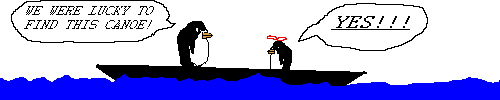

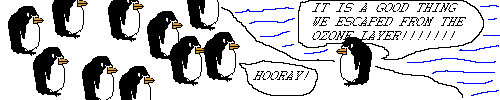
After the first comic, the audience is already expecting a poorly drawn, error-ridden comic. Havelka bumps up the ineptness of the comic, by skipping over the entire adventure in three panels. In the first panel, Pokey and the Little Girl have found a canoe; we never learn how they encountered it, or what they are doing with it. They are suddenly thrust into danger, but before any action takes place, Pokey is safe and with his fellow penguins.
The deliberately unsatisfying storytelling is still pretty traditional, though. The interesting joke in comic #2 is Pokey’s misinterpretation of the threat. Rather than saying, "It is a good thing we escaped from the hole in the ozone layer," Pokey claims to have escaped from the ozone layer itself. Thus, the comic sets up a theme of environmentalism, but annihilates the theme by misunderstanding the situation. The ozone layer itself becomes a personified enemy, and the comic’s environmental lesson is ruined.
#5 The Abandoned Castle
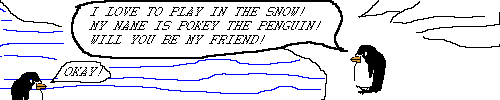
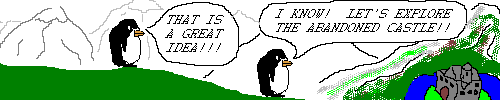


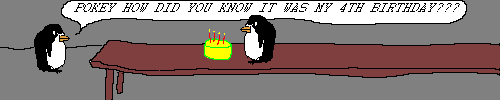
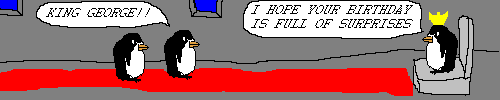
Comic #5 is usually the first comic to strike the reader as brilliant. At the very least, it is usually the first comic to make him/her laugh out loud.
The first joke that people notice is that when Pokey suggests that he and his friend fly across the river, the next panel shows them in an airplane. Penguins are birds, and birds are associated with flying. However, penguins cannot fly. Pokey’ suggestion of flying is already somewhat ridiculous, but when he appears on an airplane, his idea makes sense. Nevertheless, because of the penguin-bird-flight connection, the audience does not expect him to use a plane. This joke plays around with the reader’s expectations concerning penguins and flight.
But a problem arises in the last panel: King George’s throne room looks exactly like the interior of the plane. Was that truly a plane? Is King George on the plane? If they were not on a plane, how did the penguins fly across the river? If they are still on the plane, why are there a throne room and king? Any way you interpret the succession of panels, it is partially sensible, and partly unexplained.
The kicker, and the most typically Pokey-esque joke in the comic, is King George’s comment. Pokey meets a random penguin, and later surprises him with a birthday cake (inside either an airplane or the abandoned castle). In the climax of the tale, Pokey and his friend meet King George, a mysterious ruler who has not been introduced or explained (in fact, the castle was supposed to be abandoned). The penguins recognize King George, and his comment shows that he is aware of the random penguin’s birthday. The stupidity of his comment is astounding. "I hope your birthday is full of surprises," is an awkward, fortune-cookie-like phrase, which makes little sense after he’s already been surprised by a cake and a king in an abandoned castle (or airplane). King George’s surprise appearance seems to imply some amount of importance or profundity, but he only offers a ridiculous, almost meaningless birthday wish. It is not even clear that the phrase is a beneficent greeting. The placement of King George’s absurd phrase in the climactic/punchline position (the last panel) puts additional emphasis on the royal utterance. "I hope your birthday is full of surprises" almost fits; it is, after all, someone’s birthday, and it has been full of surprises. But upon a moment’s reflection, the statement (and the king himself) is ludicrously out of place.
#39 The Price of Love
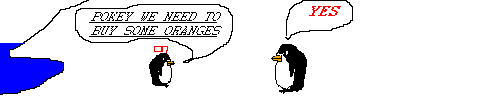
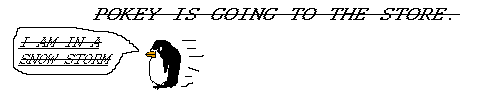
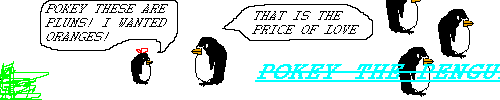
#39 is a short but deep comic, and yet another one that often evokes loud laughter. Pokey’s comment, "That is the price of love," is the punchline of two jokes. First, Pokey has disappointed the Little Girl by bringing her the wrong kind of fruit; when he names that disappointment as the price of love, we understand what he means: in dealing with those we love, we must sometimes accept less than we desire. However, Pokey’s comment is ironic in light of the unimportance of the matter. Furthermore, it seems that Pokey’s improper fruit purchase was due to either deliberately ignoring the Little Girl’s request, or the confusion of the snowstorm. In either case, love has nothing to do with it.
The snowstorm is the second joke. Pokey encounters a snowstorm on the way to the store, and we unconsciously assume that this is the reason that his fruit purchase becomes muddled. However, this makes no sense. The storm occurred on the way to the store, so there was clearly no way that the storm interfered with the fruit. The storm could not have followed him into the store. And even if the storm had hit him on the way back, that doesn’t explain his fruit getting switched. The storm represents some random event that disrupts Pokey’s efforts, but the storm is an unsatisfactory disturbance.
#100 The Devil

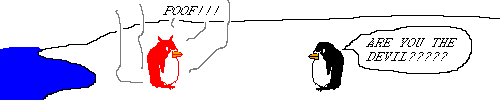
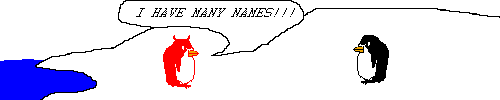
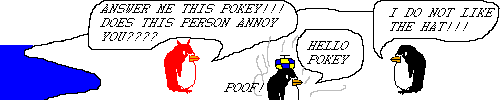
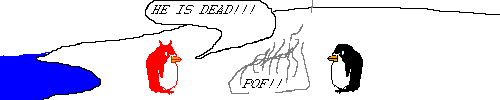
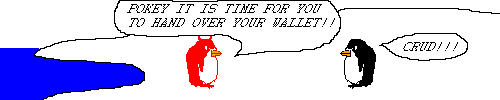
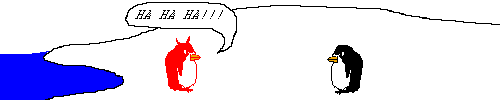

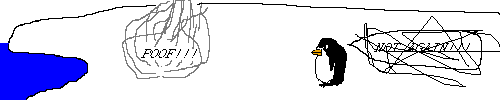
The logic of #100 is this: the Devil tricks Pokey into implicitly asking for a favor; the Devil grants Pokey the favor, and then claims his reward: Pokey’s wallet; the Devil then announces, like a motivational speaker, that he is "mastering the possibilities."
This comic is a variation on the stereotypical human-and-the-Devil confrontation. The Devil appears and tricks Pokey into making a sinful request; however, Pokey’s "request" consists of admitting he doesn’t like someone. The Devil fulfills the implied request, and then takes his payment; however, instead of Pokey’s soul, the Devil takes his wallet. Finally, instead of a sinister and proud speech before departure, the supreme master of evil makes a silly statement of self-empowerment.
#159 The Hands Are Not Clean!!
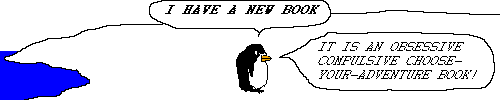
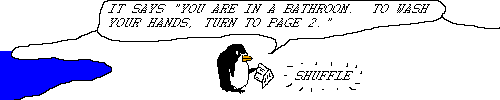
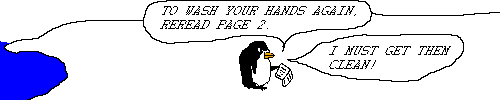
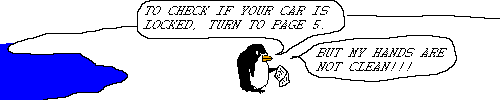
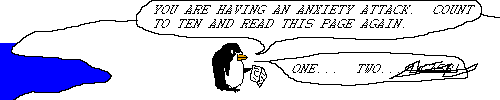
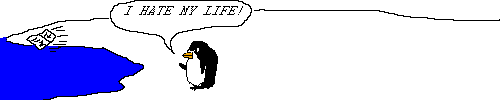
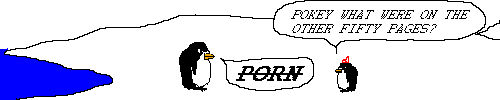
#159 begins with a pretty standard joke style. An unusual premise, an obsessive-compulsive choose-your-own-adventure book, is introduced, and the comic possibilities are explored. When Pokey throws the book into the ocean, he is committing suicide in the fictional world of the book.
The second joke comes from an analysis of the first joke. If one could not move beyond the first few pages of the book, there would be no point in having more than a few pages. The Little Girl’s question, "What where on the other fifty pages?" reveals an inconsistency in the premise. Pokey’s reply, "Porn," represents Havelka’s own thoughtlessness while establishing the premise. As Havelka created the obsessive-compulsive book without thinking the idea through, he supplies the ending pages with equal indifference.
#165 Save The Trees
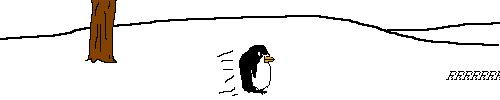
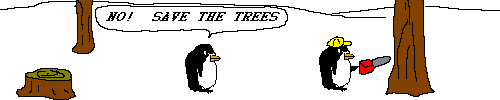
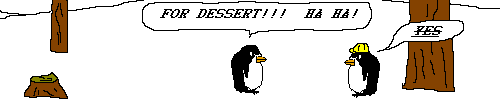
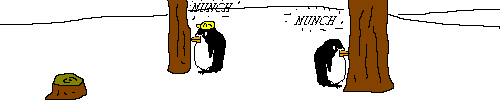
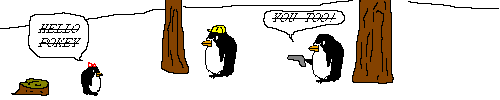
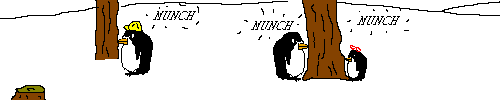
"Save the whales…for dessert!" is a sensible bumper-sticker, anti-environmental phrase. Havelka extends the phrase to another anti-environmental area in which it is ridiculous. After inventing the phrase, "Save the trees…for dessert!" Havelka applies it as a deliberate statement; Pokey and the lumberjack begin to eat trees, and force the Little Girl to join them at gunpoint. Pokey and the lumberjack are odd eco-terrorists, invented by a manipulation of a stupid anti-environmental slogan. The implied question is: would the above comic be any less ridiculous if it had involved whales rather than trees? The initial phrase is mocked by application in a new area.
#238 Hola!
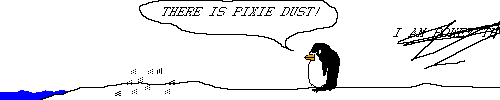

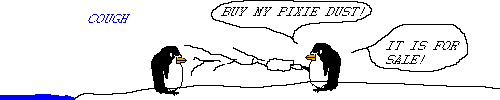
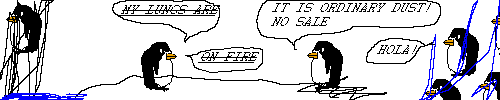

#238 is one of the many comics that inspire critics to condemn Pokey as random. Truly, I can not explain the "Hola!" portions of this comic. The initial joke involves a typical illogical-role-reversal; Pokey tries to force a customer to buy pixie dust, but upon discovering that the dust is ordinary, he refuses to sell. One would expect the customer to reject the dust upon discovering its common nature, but Pokey’s reaction implies that he is less willing to sell ordinary dust than pixie dust; in other words, pixie dust is worth less than regular dust.
My guess about the "hola" is that Havelka used the word without any deeper purpose, and then repeated it when another penguin began to enter. When he decided against the second entrance, he scratched it out, and didn’t know where to go with the comic. He wrote "hola" in the last panel because "hola" had become a running joke in the comic, but he didn’t know how to stretch out the pixie dust story any further. The last panel completes the third leg of the running gag, while admitting that the storyline had run dry.
Chapter 2
Zahutu’s Leaflets: Concerning the Three Incarnations
By Dr. Chester I. Zinchief
Of three incarnations of the artist I will tell you; how the artist becomes a little girl; or a penguin; or a snowman.
There is much that impedes the artist, the patient servant who would produce any desired thing: but the greatest and most persistent barrier is that which the artist must assail.
What is this impediment? asks the artist that would be known, and listens dumbly like a little girl, awaiting instruction. What is this great impediment, O masters, asks the artist that would do anything, that I may learn its ways and strength? Is it humbling oneself to the virtues of the past? Letting their wisdom shine through to mock my own?
Or could it be: jumping onto the largest ship, even if it is overcrowded? Taking long journeys to consult with the ancient kings, even when they are grown mute?
Or could it be: eating the oatmeal and smeat of beauty and, for the sake of popularity, suffering boredom in one’s mind?
Or could it be: feeling ill and asking strangers to comfort you, and making friends with the deaf, who speak and never listen?
Or could it be: plunging into freezing oceans when they are the oceans of beauty, and not avoiding jellyfish and crabs?
Or could it be: worshipping those that despise us and resurrecting the ghosts that have left us?
All these barriers the artist that would become popular must take upon herself: like the little girl that, instructed from overpowering masters, learns without effort, and acts without question, and eschews the tempting void of the Poles.
On the barren iceflows of the Arctic, the second incarnation appears. Here, the artist becomes a penguin, isolated from the concerns of the world and master of his domain. He hunts in isolation, he evades his final enemy: he wants to escape him and the words of god; for immortality he must avoid battle with the Irate Iguana.
What is this giant lizard whom the artist will not obey? "Thou shalt, Pokey! Now!" is the name of the giant lizard. But the penguin-artist says, "No, green-eyed dragon, I will!" Irate Iguana stands in his way, distracting as a stoplight, surrounded by his motorcycle cavalcade; and on every biker’s shoulder is a tattoo that says, "Thou shalt, Pokey! Now!"
Aesthetics, centuries and centuries old, are discussed by the bikers in this cavalcade; and the mightiest of lizards speaks thusly: "All beauty is owned by me. All beauty has long been discovered, and I am all discovered beauty. Truly, I say unto you, there can be no more ‘No, green-eyed dragon, I will!’" This says Irate Iguana.
Dear friends, what good is the artist who is a penguin? Why should the little girl, who is obedient and imitative, not suffice?
To find new beauty--the penguin will not often do; but the discovery of artistic freedom for new creation--that is the chief goal of the penguin. The example of liberty and the damned refusal of all convention--these are the products of the penguin. To evade the past and shirk its boundaries--that is an impossible goal for the little girl that would remain loved. Truly, to her it is destructive, and better left to solitary creatures. The little girl must worship "Thou shalt, Pokey! Now!"; the penguin must dismiss these orders through deliberate ignorance, and seek only his own path, that freedom from beauty may become his goal: the penguin is needed for such triumph.
Now look look now, friends, what can the snowman do that the penguin can not? Why must we seek out the living simulacrum and leave behind the penguin? The snowman is experience and erudition, a new conclusion, a game, a mocking and parasitic machine, a moved mover, a blessed "Maybe." For the creation of art, my friends, a blessed "Maybe" is necessary: the artist now chooses his own rules, unearths the riches of the penguin, and reinvents the world.
I have now told you about three incarnations: how the artist becomes a little girl, or a penguin, or a snowman.
This said Zahutu. Then he set off again, to the band that is called the Motley Crew, to find his long-lost parka.
Reflections
A fair complaint levied against Pokey the Penguin is that the reader receives far too little indication of the author’s ability and intent. There are hundreds of web comics superficially similar to Pokey, and one cannot be reasonably expected to investigate them all in good faith. The vast majority of sloppily drawn, cut-and-paste comics are random, unamusing, and shallow. Even if we allow that Pokey the Penguin is an exceptional comic, the amount of inspection required to see the smallest fraction of Pokey’s aesthetic value would tend to deter serious critics.
The traditional conception of artistry is not a sudden "incarnation," but a gradual evolution. Artists are expected to study the works of past masters (phase 1), gradually increase their own abilities according to traditional standards, and, if particularly masterful, come to reject old standards (phase 2) or create new ones (phase 3). In our current world, where art has no defined boundaries, this traditional evolution helps to protect the artistic world from talentless shams; a proven artist can experiment in abstract forms, but one with no clear talent will not easily find recognition (in theory, anyway). Steve Havelka clearly belongs in the category of unproven artists, and thus encounters difficulty in presenting his work.
Zahutu’s leaflet of the three incarnations contradicts the principle of artistic evolution, naming instead three different categories of artists that do not evolve into further forms, or each other. The Little Girl serves only the desires of others, shaping her art according to current standards of beauty and current topics of interest. She studies successful artists of the past and follows their principles; she will do whatever is required to become popular and loved. Zahutu uses the word "beauty" here as a powerful restriction upon art; "beauty" being a highly variable and subjective term, those who seek to create beauty only serve popular sentiment and ancient prejudice.
The Penguin is an artist working in ignorance of all rules and conventions, seeking only to entertain and educate himself; he must constantly avoid knowledge of aesthetics and artistic theories. The Irate Iguana represents the body of aesthetic theory that, upon discovery, will spoil the pure creations of an ignorant artist. The Penguin is not necessarily superior to the Little Girl, and his output is not generally of any particular worth, but his creations will serve as an example for the Snowman.
The Snowman is the supreme artist, familiar with other artists and theories, but following or skirting custom as he sees fit. Unlike the Little Girl, the Snowman can create new forms of art and beauty; unlike the Penguin, the Snowman can build upon the accumulated knowledge of past artists. The Snowman must have the ability to discern which customs are of use to him, and which are not; he must have the ability to not only break with tradition, but to create as if he had never known it. The Snowman is not a simple evolution from either of the lower forms, and he gains knowledge from the experiments of both.
The most significant claim of Zahutu’s leaflet is that an artist’s work can actually suffer from over-exposure to aesthetic theories. Once one has knowledge of how things "should" be done, it becomes difficult to otherwise, except in a self-conscious and inhibited way. For example, Beethoven may be thought of as the archtypal "evolved artist," beginning with quite normal compositional styles and later deviating more and more from traditional forms. However, even at his most unique, Beethoven sounds more like Mozart than a jazz quartet. There is no reason why Beethoven couldn’t have moved toward jazz-like music (although many would argue it’s a damn good thing he didn’t), but neither he nor any other traditionally schooled composer created anything even vaguely resembling jazz. Jazz (and later rock and roll, and later rock’n’roll, and later rap) came from uneducated people making music however it pleased them (of course, well-educated composers later moved into popular styles). If all musical artists had been instructed in classical composition, popular music would be quite different today, if indeed any kind of massively popular music would exist at all.
However, jazz and rock’n’roll are not better than classical music. While the Penguin is singing Yesterday and the Little Girl is playing Moonlight Sonata, the Snowman is listening to both and taking in what he desires. We may argue about who are the Penguins and Snowmen and Little Girls in the musical world, but that is of no great concern here. In the world of comic art, Steve Havelka is an archetypal Snowman. His comics are a mixture of playful experimentation and deliberate creation that would not come from an experienced cartoonist.
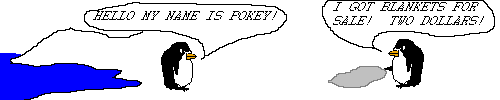
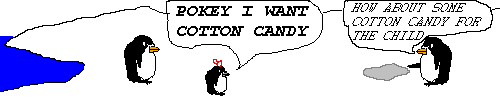
The two panels above are the beginning and ending of comic # 20 (Blankets For Sale). Although the intervening panels distract from the "punchline," the funny part of the comic is that Havelka’s rendering of a blanket is an amorphous blob that could equally well represent a plethora of other items. The Comic does not develop with any intentional movement toward the ending joke; rather, Havelka discovers the ambiguity of his drawing and decides, on the spot, to make a joke out of it. This joke requires the ability to step back and see the comic as others would, to think about the multiplicity of images, and to alter a premise in mid-comic. It also requires that the artist draw very poorly. Havelka’s comics often rely on a balance of amateurish goofiness and highly refined observations.
[Editor’s note: The next seventy examples have been omitted.]
Chapter 3
Havelka
by Marty Steven
Marianne: Ah, affirmative, the man's an artist. I viewed the art. Havelka let me have one of his pictures.
Eddy: To what things are they similar?
Marianne: The pictures are unusual, in reality. (Marianne gestures at a gibbon drawing upon the interior.) Unlike this, I inform thee.
Eddy: Not a bit incorrect in this drawing. Obtained the thing from the home of my mother's mother pursuant to her passing; yeah, really as the old woman was in the process of passing. Monkey on a chifferobe. Mist. Pulchritudinous.
Hawking: This I observe not.
Eddy: But describe your insight then, renowned cosmologist Stephen Hawking.
Hawking: It is my desire to investigate deeper. Notice that the gibbon is drawn large, dominating the furniture and climate. Therefore I intake "the might of the large beings above the environment." To myself, the significance is what infuses the painting with virtue.
Bastion: [dismissive] By Jove! Gibbon. Chifferobe. Mist. Punctuation.
Spaneesh: Trouble exists.
Hawking: How?
Spaneesh: Hell, to this girl it appears that when you rate a drawing only by what it signifies, a lousy drawing would be just as great as a well-drawn drawing if they signify similarly.
Hawking: Females!
Reflections
The selection above raises an interesting question, but Hawking’s reaction is even more telling. If art is important only insofar as it means something, then what does it matter whether art is expertly or ineptly done? Does not a given statement carry the same truth-value whether it is written sloppily or in beautiful calligraphy?
Hawking reacts to Spaneesh’s question with dismissive name-calling. He somehow knows that poorly drawn pictures are worse than well-drawn ones, but he can give no reason why it should be so. If he hadn’t acted dismissively, the questioning might have gone further: if art’s only value is in meaning something, how is it superior to a simple statement of the intended meaning?
Clearly, if an artist intends only to communicate some clear message, he/she needn’t be concerned over minute imperfections (like distracting word repetitions). But, if an artist intends only to communicate some clear message, he/she might as well write it down. A drawing of a gibbon that signifies "the might of the large beings above the environment" could easily be replaced by the statement, "The might of the large beings above the environment."
Of course, great art rarely has as its subject a single message, and the messages it does contain are rarely clear. Pokey the Penguin works with bad drawing because its characters are largely iconic; in any given comic, Pokey the Penguin might represent a certain philosophy, Mr.Nutty might represent the bourgeoisie, or Skeptopotamus might represent gangster rap. In such cases, they characters do not need to be detailed or beautiful. They are part of Pokey’s basic grammar, and communicate ideas as directly as words. Pokey the Penguin succeeds with poor artwork because of the meaning of its characters and environs; however, its messages could not be replaced by simple statements, as they are often ambiguous, mysterious, or inexpressible outside the Pokey grammar.
The end